 Request Consultation
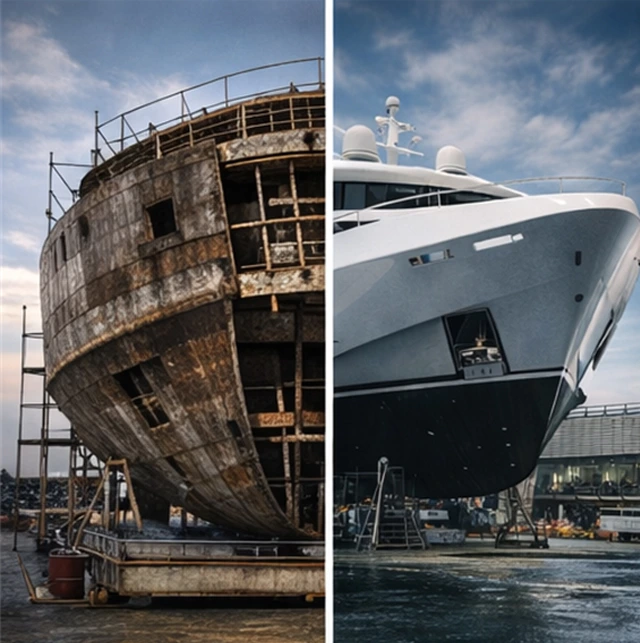
Engineering realities behind the decision
In the lifecycle of many yachts, owners eventually face a fundamental technical decision: whether to proceed with a refit program or to undertake a deeper structural rebuild.
At first glance, both options may appear similar. In practice, however, the engineering implications and long-term outcomes can differ significantly.
Understanding the structural realities behind these choices is essential for making a rational investment decision.
A refit generally focuses on upgrading or replacing systems while maintaining the original structural framework of the vessel.
Typical refit interventions may include:
• propulsion system upgrades
• electrical system modernization
• navigation and control system replacements
• interior refurbishment
• equipment updates to meet regulatory or operational requirements
In many cases, a well-planned refit allows owners to significantly improve reliability and operational performance while preserving the original hull structure.
When the underlying structure remains sound, refit programs can provide an efficient way to extend the lifecycle of a yacht.
There are situations, however, where a conventional refit approach may no longer be sufficient.
Structural factors that may require deeper intervention include:
• significant hull fatigue or corrosion
• outdated structural design relative to current operational expectations
• major layout changes requiring structural modification
• repeated system replacements constrained by legacy architecture
In these cases, the project may evolve from a refit program into a more extensive structural rebuild.
A rebuild typically involves structural interventions that go beyond system upgrades.
This may include:
• modification of structural elements
• partial reconstruction of the hull or superstructure
• significant layout reconfiguration
• integration of entirely new system architecture
Such projects often require deeper engineering evaluation and more complex planning compared with conventional refit programs.
While rebuild strategies can deliver significant improvements, they also introduce higher technical and financial complexity.
In some cases, owners choose a phased approach between refit and rebuild.
Rather than performing all structural modifications at once, the project is divided into carefully planned stages.
This approach can allow owners to:
• spread investment over time
• maintain operational availability between project phases
• evaluate technical results before proceeding with further structural work
However, phased reconstruction strategies require careful engineering planning to ensure compatibility between project stages.
The decision between rebuild and refit ultimately depends on a clear understanding of the vessel’s structural condition.
Key evaluation areas typically include:
• hull structural integrity
• material fatigue or corrosion patterns
• structural load distribution
• compatibility with modern systems and equipment
A thorough technical evaluation allows owners to determine whether the existing structure remains suitable for long-term operation.
Beyond engineering considerations, rebuild and refit decisions must also be evaluated from an investment perspective.
Key questions often include:
• how much of the vessel’s structural value remains intact
• whether modernization can be achieved within existing architecture
• how the investment compares with replacement options
• the expected operational lifecycle after intervention
In some cases, a rebuild may offer a more efficient long-term solution than repeated partial refits. In others, preserving the existing structure through targeted upgrades may be the more rational choice.
The distinction between rebuild and refit is not merely semantic. It reflects fundamentally different levels of engineering intervention.
A refit focuses on upgrading systems within an existing structural framework.
A rebuild involves deeper structural modification that reshapes the vessel itself.
Determining the appropriate path requires a structured evaluation of structural condition, operational objectives and long-term asset value.
In this sense, the rebuild versus refit decision is best understood not as a technical preference, but as a strategic engineering choice.